the invisible tax
The $2 fee on a $100 card payment splits three ways, and the slice nobody can see, Visa and Mastercard's scheme fee, is the one no country caps.
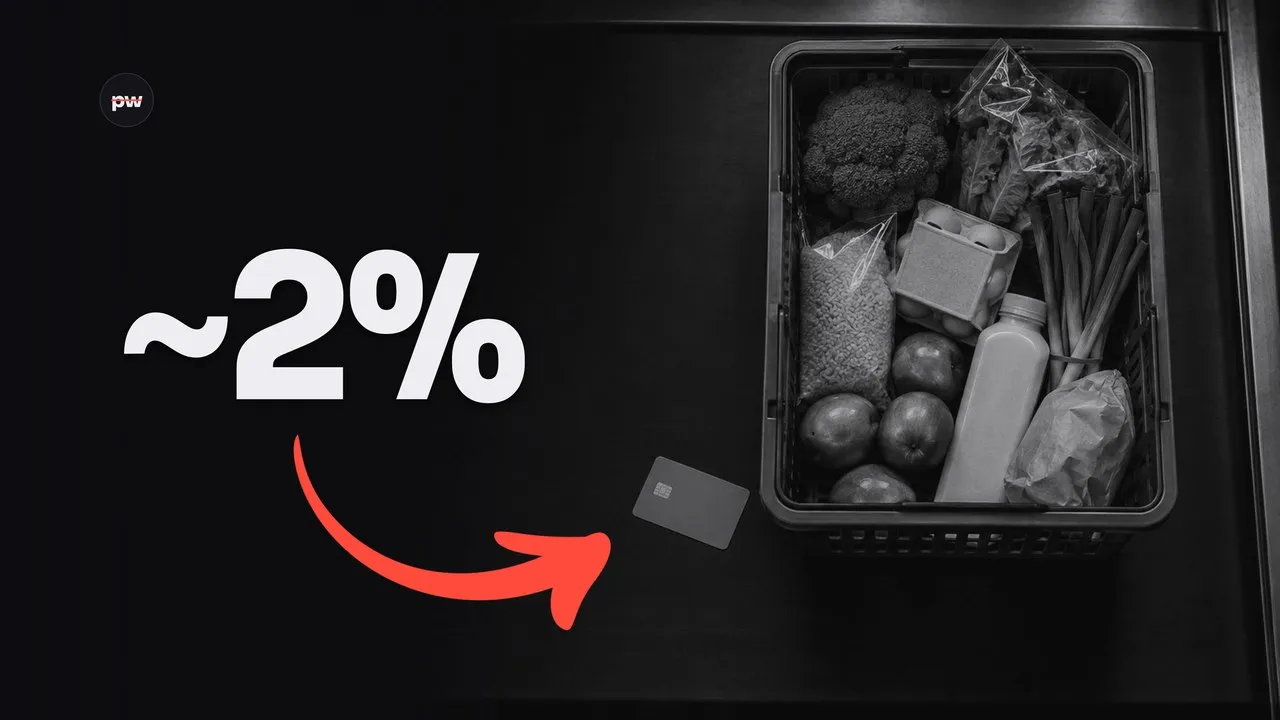
Look at your last grocery bill. Whatever the total was, the shop received less if you paid by card. Say the total was $100. If you’re in the United States, the shop keeps about $98S1 of it. In Europe, closer to $99S1, and in some parts of the world, under $97. The difference is the fee for accepting your card, and it comes off before the shop sees any of the money.
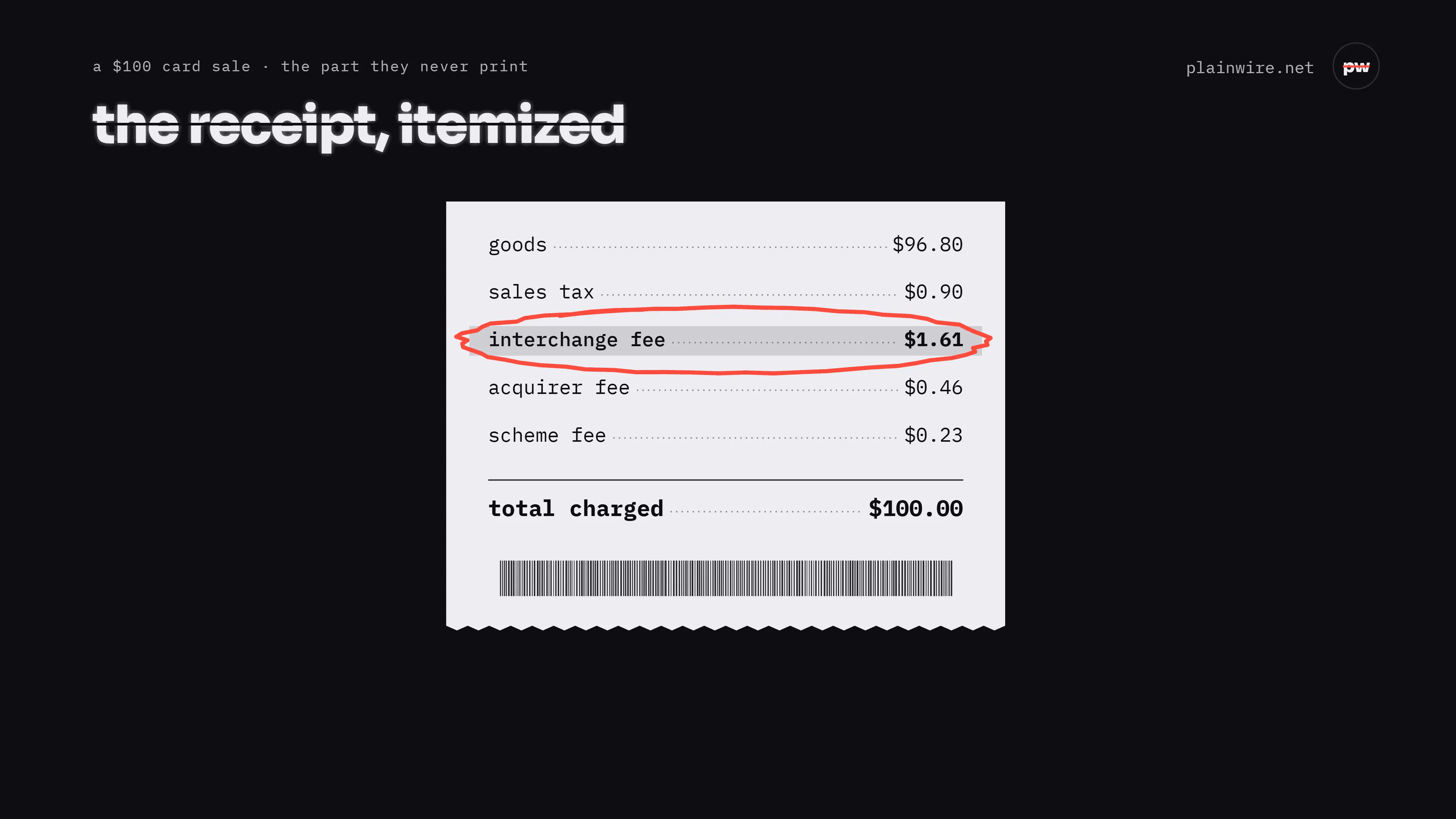
A $100 card sale, itemized: the card fee is the line a receipt never shows. Illustrative figures, based on Visa’sS1 and Mastercard’sS1 published rates.
Say the fee is $2. Most people know this fee exists. What almost nobody can tell you is where those $2 go. They split three waysS3. Most of it, call it $1.50, goes to the bank that issued the card in your wallet. The shop’s own payment company, a company like Stripe, takes a cutS3. The smallest pieceS3 usually goes to Visa or Mastercard, for running the network your payment traveled over. The industry calls Visa and Mastercard payment networks; you’ll also hear card schemes, or payment rails, and they mean the same thing. American Express and Discover are payment networks too, just smaller ones. Of every dollar Americans put on those four networks, about 87 centsS1 runs on Visa or Mastercard.
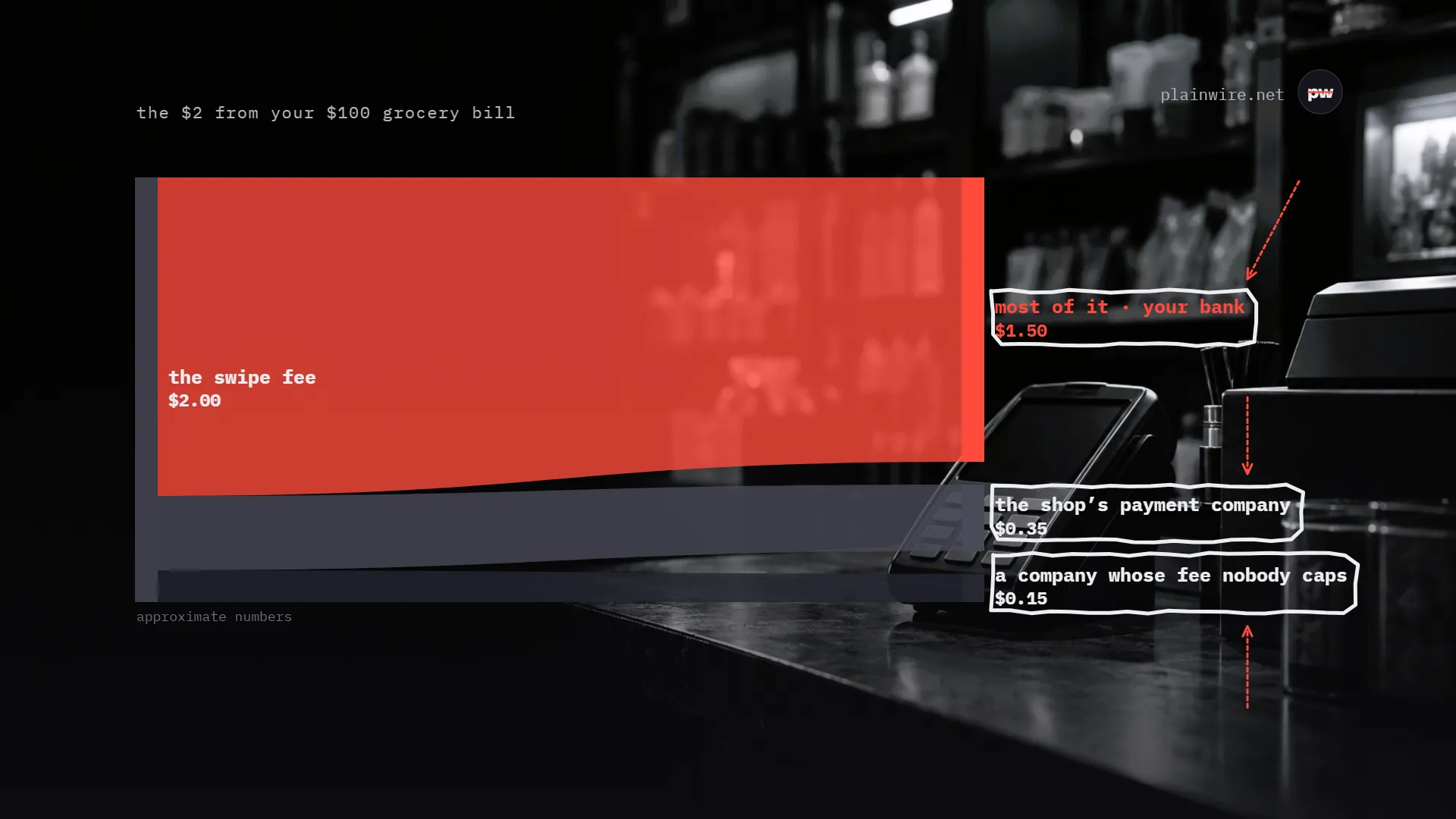
Where the $2 goes on a $100 card payment in the United States, approximately. Sources: Payments MasteryS3, FinixS3.
So there are three slices, and one of them is not like the other two. The bank’s slice, called interchange, is capped in places like the EUS1, Britain, AustraliaS1, BrazilS1 and CanadaS1. Every rate is published, by VisaS1 and MastercardS1, so you could look them up right now. Politicians campaign on itS3. In the United States, it has been in court for 21 yearsS2. The shop’s payment company’s slice, the acquirer fee, usually isn’t capped, but it is negotiable, so a shop that pushes hard can find out what it’s paying. Then there’s Visa and Mastercard’s slice, the scheme fee. According to Australia’s central bankS1, no country regulates it. Its rates aren’t published anywhere, and no country has ever managed to cap it.
Then, in March 2026, Australia’s central bank did something no regulator had done in years. It researched the card swipe fee, broke it down, and published the answer in a 200-page reportS1. Here is one example from it. Take an ordinary $100 sale, in an Australian shop, on an Australian card. The shop pays about 59 cents in total to receive the payment, and about 10.5 centsS1 of that goes to the card networks: Visa, Mastercard and Australia’s own network, eftpos.
Now take the same Australian shop and the same $100, except this time a tourist pays, with a card issued in another country. The total fee jumps from 59 cents to $2.73, and the card networks’ share of it goes from 10.5 cents all the way up to $1.58. That’s over $2 of extra cost on the same sale, purely because the card came from abroad. On the local sale, Visa, Mastercard and eftpos take about a sixth of the total swipe fee. On the foreign card, Visa or Mastercard alone take more than half, in the same shop, on the same $100.
That charge from Visa and Mastercard is called the scheme fee. In over 68 years, almost nobody outside those two companies has been allowed to see what’s inside it.
the two seconds
What you experience during the sale is almost nothing: you swipe the card, and about two seconds later it says approved. Underneath that, three separate things happenS3, and only the first one is fast. The first is authorization, and that’s the two seconds: the card terminal asks the shop’s bank, the shop’s bank asks a network, the network asks your bank, and your bank says yes or no. Then nothing happens for hours. The second step is clearing: that night, everyone compares notes on who owes what. The third is settlement, one to three days later, when the money moves. That’s why a refund takes days to appear. The shop isn’t being slow; the money hasn’t gone anywhere yet.
Five parties are involved. There’s you, and there’s the shop. There’s the bank that issued your card, which the industry calls the issuer. There’s the shop’s bank, or more often the shop’s payment company, called the acquirer: companies like Stripe and Adyen. And in the middle, connecting the issuer and the acquirer, there’s VisaS1 or Mastercard.
Follow that $100 and assume a 2% swipe fee. You tap. Two days later, your bank sends the money to the shop’s bank, but it doesn’t send $100. It sends about $98.50 and keeps $1.50 for itself. The shop’s bank or payment company then takes its own cut and pays Visa or Mastercard for using their network. What’s left, about $98, is what the shop gets. Here’s the part almost everyone has backwards. Ask someone where the swipe fee goes and they’ll say the payment networks, Visa or Mastercard. But the biggest piece, the $1.50, never went to Visa or Mastercard. It went to your bank, the bank that issued your card. That piece is called the interchange fee, and Visa and Mastercard set the rate for it, publish the rate, and then hand every cent of it to banksS1.
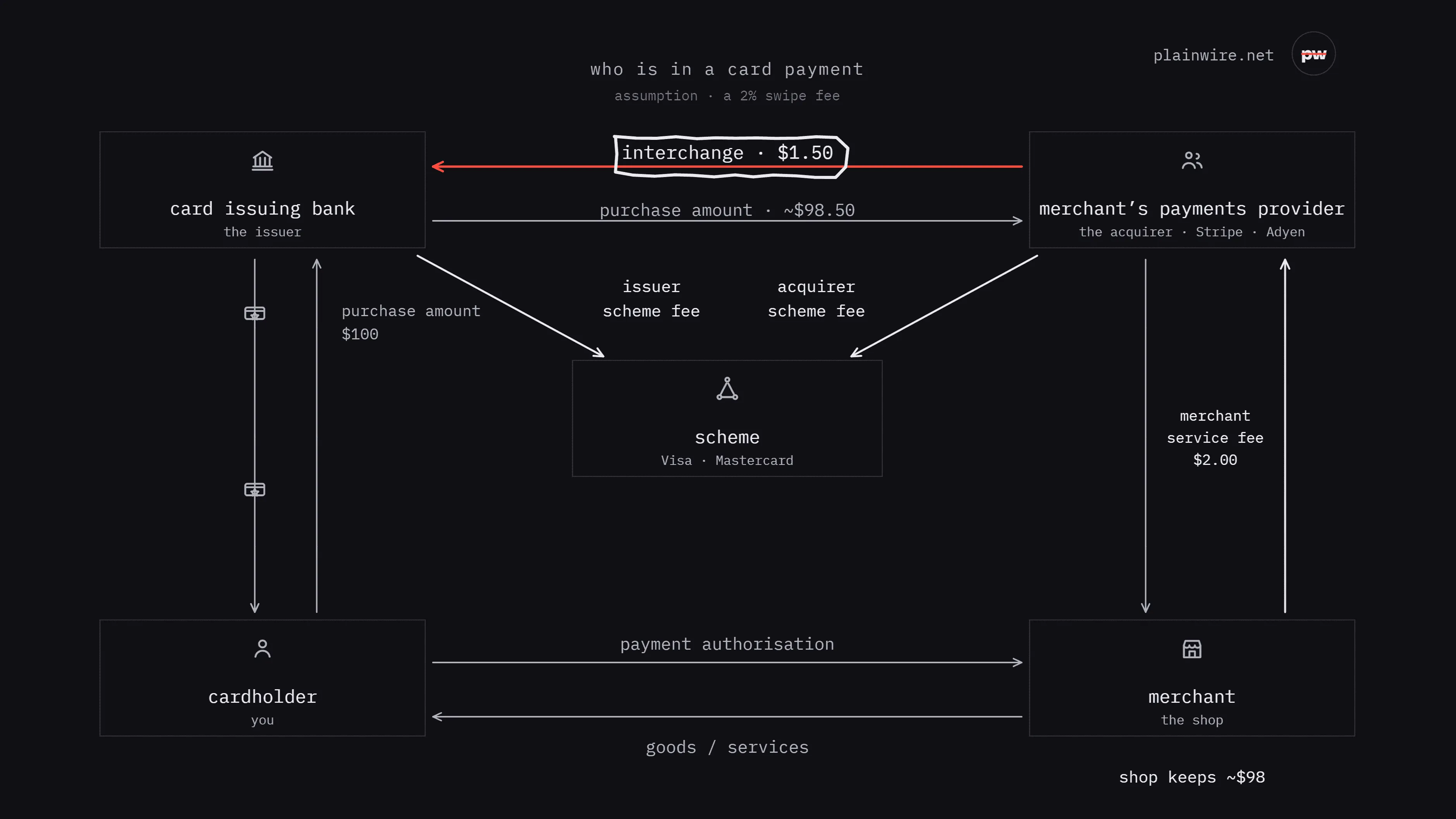
The five parties in a $100 card payment with a 2% fee, after Figure 1 of the Reserve Bank of Australia’s conclusions paper. Source: Reserve Bank of AustraliaS1.
Visa says so itself, in its annual reportS1 filed with United States regulators: “Visa is not a financial institution. We do not issue cards, extend credit or set rates and fees for account holders of Visa products.” Visa and Mastercard receive the smallest of the three slices, the scheme fee, and unlike the interchange fee, that slice has no published rate anywhere. As for your bank’s $1.50, some of it comes back to you, as points, cashback, or an airport lounge you’ve never used.
The swipe fee is a percentage, which means it grows by itself. Authorizing a $10 payment and a $1,000 payment takes almost exactly the same amount of computing, the same message and the same two seconds, but the fee on the second one is 100 times bigger. So when prices rise, this fee rises with them, automatically. In the United States alone, card fees came to $187 billion in 2024S1 and $198 billion in 2025S1. That’s what merchants paid, in one year, to be allowed to take payments by card.
Here’s the comparison that makes that number matter. On a credit card in the United States, the total swipe fee works out at about $2.30 in every $100. The average United States supermarket’s profit on that same $100 is about $2.10S3. The store pays more to take the money than it makes on the sale.
On a $100 credit card sale in the United States, the swipe fee is larger than the average supermarket’s profit. Sources: The Nilson ReportS1, FMIS3.
the swipe tax
If the swipe fee costs the shop more than the sale makes it, what can the shop do? Three things, and only one of them is a real option. It could refuse cards, but in Australia, for example, cards are 70% of every payment customers make in shopsS1, and refusing cards means refusing most of your customers. It could charge customers extra for paying by card instead of cash, but that’s banned across most of the world, either by law or by Visa and Mastercard’s own rules. That leaves one real option: the shop puts the fee into the price of its goods and services.
So the fee isn’t really paid by the shop at all. It’s paid by everyone who walks in. Now look at the person paying cash. They pay the same $100, at the same shelf price, raised by the same fee. They just don’t have a card, so no rewards come back to them: no points, no cashback, no lounge.
So who is the fee coming from? The Federal Reserve Bank of BostonS1 modeled that in 2010, and the answer runs through the shelf price. Shops can’t charge card users more, so they raise prices for everyone, and card users then get a slice of it back as rewards while cash users get nothing back. Net that out, and the average cash-paying household is about $149 a year worse off, and the average card-paying household is about $1,133 better off. The 2010 model was a while ago, and it has critics, including PERCS3 and the International Center for Law & EconomicsS3. A more recent measurement looks at something slightly different. In 2023, economists at the Federal Reserve Board and the IMFS1 went through the Fed’s own data on more than 200 million American credit cards and tracked where the rewards money comes from. They found $15 billion a year moving from households with less education to households with more education, and from poorer areas to richer ones. Their sentence for the mechanism is this: “Profits from naive revolvers fund the rewards extracted by sophisticated transactors.”
People with rewards cards are usually offered the same deal. The ones who work it out, who pay in full, never carry a balance and collect the points, come out ahead. The ones who don’t, who carry a balance and pay the interest and the fees, are funding them: the same card, on the same terms, with opposite outcomes. Put the two findings together. If you’re paying cash, you’re paying for cards you don’t have. And if you have a card and carry a balance, you’re paying for somebody else’s air miles.
This is where the usual framing breaks down. The argument about swipe fees is usually framed as shops against banks: two sets of large companies arguing over a margin, with no obvious reason for anyone else to care. But shops can’t absorb a 2% charge on a 2% profit, so it goes into the price of what they sell. That makes the swipe fee something very close to a tax, set privately, collected privately and paid by everyone, including people who don’t have a card and never agreed to anything.
the fee nobody can see
If everyone is paying the fee, you’d expect to be able to find out what it is. For one of the three slices, you can: the interchange fee, the bank’s slice, the big one. Its rates are published on Visa’sS1 and Mastercard’sS1 own websites, and they’re capped by law across most of the world. The other two slices are different. The shop’s payment company sets its own margin, though it can be negotiated. That leaves the network’s slice, Visa and Mastercard’s own cut, the scheme fee. The scheme fee is a bundle of fees, and none of their rates are published. When Australia’s central bankS1 went looking for a country that regulates them, it found it was “not aware of scheme fees being directly regulated in other countries.”
That produces an odd result. Almost every major payment reform since 2011, in every country that has attempted one, has been aimed at the slice that goes to the banks, and not at the slice Visa and Mastercard keep. Visa and Mastercard do compete with each other, but not for you, and not for the shop. They compete for your bank, because your bank picks whose name goes on your card, and one of the ways they win a bank is by offering it a bigger cut of the interchange fee. So when Visa and Mastercard compete, the fee can go up, not down. There is a fair reason regulators focus on interchange. It’s the bigger number, usually around 70% of the total swipe feeS3, and it’s the one with published rates, so it’s the part a regulator can get hold of.
Interchange and the acquirer fee aside, why has no regulator been able to measure the whole scheme fee bundle and what’s inside it? There have been attempts, and two regulators have come close: Australia’s Reserve BankS1 and Britain’s Payment Systems RegulatorS1. In Australia, there are so many separate charges that some of the banks and payment companies paying them asked the Reserve Bank to cap how many fees a network is even allowed to have. Visa and Mastercard’s network fees usually fall into three kinds: mandatory fees, which you pay simply to be in the network; optional fees, for services a bank or a payment company can turn down; and behavioral fees, which exist to push those companies into doing something a particular way. Ask what all of it is for, and the networks’ answer is broad: authorization, processing, fraud prevention, building the network and maintaining it. One of those behavioral fees, taken straight from Australia’s regulatory file, shows how this works. A customer’s card gets declined. They try again, and it declines again. The third time, it works. The shop is charged a fee for every attempt, including the two that failed, and the Reserve Bank notes that charges like this are “not always avoidable.”
Britain’s Payment Systems RegulatorS1 ran its own review and found that Visa and Mastercard had raised their core fees by at least 25% since 2017. That’s at least £170 million a year, extra, out of British businesses, a cost that was likely passed on to British consumers.
The British regulator also concluded that Visa and Mastercard do not face effective competition. Australia, working separately on the other side of the world with different data, reached almost the same wording: its Payments System BoardS1 concluded that scheme fees, “particularly for credit cards, are not subject to effective competitive constraints.” That may not sound like news to a lot of people, but it matters when two major regulators put it on the record.
What about the private sector: can’t the companies that pay these scheme fees measure them? The answer is in Australia’s own paperwork. When the Reserve Bank asked the payment industry to explain these fees, most of the companies that pay them said they couldn’t, because their contracts with Visa and Mastercard prevent it. The Reserve Bank’s conclusions paperS1 puts it like this: “Most submissions received by the RBA noted exceptionally strict confidentiality terms and information restrictions in their contractual arrangements with the card networks, which effectively prevents them from comparing pricing, or in some cases, understanding their own billing accounts.”
Some of the companies that are critical would only say so privately, rather than in a public submission, because they were worried about what the Reserve Bank calls “potential negative commercial repercussions” if they were openly critical. Some of these critics went further. They argued that the complexity isn’t an accident, that it is “a deliberate feature of card network pricing designed to obfuscate the true cost of services to extract more fees.”
In some cases, payment companies have stopped trying altogether. The Reserve Bank found that certain payment companies have “elected not to invest resources in ensuring they are consistently billed correctly,” because the fees are “opaque, complex and frequently revised,” and it costs them less to absorb the errors than to find them. So there are companies handling billions of dollars of payments that have worked out that below a certain point, it’s cheaper to be overcharged than to check.
Capping scheme fees has been considered. Australia’s Reserve Bank looked at itS1, and many of the companies that gave evidence asked it to. It decided it couldn’t, because it doesn’t have enough information about Visa and Mastercard’s own costs to know what a fair number would be.
how it got built this way
How did it get like this? The first payment card, Diners Club, was issued in 1950S3, after the businessman Frank McNamara forgot his wallet and went looking for a universal way to pay. American ExpressS3 followed in 1958S1. Both were one-company operations: the same company issued the card, billed you and paid the shop. They were charge cards, so the cardholder had to pay the bill in full every 30 days. You couldn’t carry a balance from month to month, and there was no revolving interest. What changed things was banks getting into it, and that’s where the modern credit card story begins, in Fresno, CaliforniaS3, on the 18th of September 1958. That afternoon, 60,000 people opened their mail and found a rectangle of plastic nobody had asked for. It was already active. It carried a line of credit of up to $500, which in 1958 was serious money, around $5,800 in today’s moneyS1, and there had been no application and no meaningful credit check. The man behind it was Joe Williams, who ran a department at Bank of America. He chose Fresno partly because Bank of America already banked about a quarter of the town, and partly because if it went wrong, he expected nobody outside Fresno would hear about it.
It went wrong. Williams had expected about 4% of people not to pay. It came in at 22%. The more telling part is what happened with the shops. Bank of America had spent six months persuading 300 Fresno businesses to accept the card, and the terms were that each of those businesses handed over 6% of every sale. The shops started complaining immediately, which is, as far as the record shows, the oldest continuous argument in this industry: day one, in one California town, the merchants were already objecting to the card fee. Despite the objections, most of the businesses kept accepting it, because the card brought customers.
Today’s structure comes from what happened next. In 1966, the Bank of Delaware made the first prototype of a debit cardS2. The same year, a group of banks that competed with each other in every other line of business got together and built their own version of the cardS1. It became Master Charge, then Mastercard. Bank of America’s original card became Visa in 1976. Both Visa and Mastercard started as cooperatives, owned by their member banks. So the banks jointly owned the network, the network set the fee, and the banks collected it. Years later, in 2005, merchants suedS2.
With the lawsuits building, both networks sold shares to the public, turning companies owned by their member banks into companies anybody could buy a piece of on the stock market. That didn’t make the lawsuits go away. What it changed was who ended up carrying them, and that turned out to matter. Mastercard went first, in 2006, raising about $2.4 billionS2. Most of that money went to redeeming sharesS1 from its roughly 1,400 member banksS2, paying them to give up part of their ownership. Visa followed in 2008, raising $19.1 billionS1 the largest IPO in United States historyS2 at that point. Of that $19.1 billion, $13.4 billion went straight back to the banks to redeem their shares, much as at Mastercard, and $3 billion went into an escrow account, a pot of money locked away for one purpose, which Visa’s own filing describes as covering its liability in the interchange litigation.
That escrow account is still open. In December 2025, Visa authorized another $500 millionS1 into it. What matters is who pays for it. Visa has two kinds of shares: ordinary ones, held by the public, and a separate class held mostly by banks. That second class isn’t ordinary stock. It converts into ordinary shares at a set rate, and every time Visa puts money into the escrow, that rate is cut, so the bank shares turn into fewer ordinary shares. That’s how the banks absorb the legal costs while the public’s shares are untouched. So look at the sequence. The banks were bought out in the share sales, in cash. The banks carried on collecting the interchange fee. And the banks kept the legal bill.
the reform that never arrives
Governments have tried to fix this, repeatedly, and in some wealthy countries more than once. The United States, the EU, Canada and Australia have all tried, and the same thing happens each time. Start with the United States.
There’s a truck stop in North Dakota called Corner Post. Diesel, coffee, snacks. Corner Post started taking cards in 2018, and over the following three years it paid hundreds of thousands of dollars in interchange fees to banks it has no relationship with. In 2021 it sued the Federal Reserve, the United States central bank. In July 2024, Corner Post won at the Supreme CourtS1, but not on the fee. What it won was the right to bring the case at all, because the Federal Reserve had argued the deadline for challenging the rule expired before the truck stop existed. So Corner Post went back to a lower court, and in August 2025 a judge struck downS2 the rule that sets debit card fees for the entire United States. The rule still stands, though, because the same judge later suspended his own rulingS2, in his words to stop interchange fees “from becoming a completely unregulated market.”
The rule Corner Post was fighting has a name: the Durbin Amendment, passed into United States law in 2010 and turned into a Federal Reserve ruleS1 that took effect in 2011.
It did two things. It capped the interchange fee on debit cards at large banks, and it forced every debit card to carry two networks not owned by the same company, so the shop gets to pick which one the payment runs through. Credit cards got neither, and credit spending is bigger than debit in the United States: more than halfS1 of American card spending runs on credit. You might reasonably ask why a truck stop would sue to overturn a cap that was supposed to help it. There are two reasons. First, the fees Corner Post was paying went to the banks that issued its customers’ cards, which is how interchange works. Second, Corner Post wasn’t arguing against having a cap. It was arguing that the cap had been set far too high. The law says the fee has to be reasonable and proportional to what it costs a bank to process the payment. Corner Post’s case was that the Federal Reserve had padded that calculation with costs such as fraud losses and network processing, so the ceiling landed well above the real cost. In August 2025, the court agreed. That’s also why the same judge then suspended his own ruling: strike the rule down, and there is no ceiling at all. Separately, the Federal Reserve went back and studied what its own rule did.
The banks lost debit fee revenueS1 because of the Durbin Amendment and only partly made it back. A study published in 2025S1 found where they made it back. The banks recovered about a seventh of what they lost by roughly doubling checking account fees. And because the cap made debit less profitable, they pushed credit cards instead, which carry a higher fee, so the swipe fee overall may have gone up rather than down. The Federal Reserve also surveyed merchants afterwardsS1 and found that most had not changed their prices at all, and some had raised them.
Europe went further. In 2015 it directly capped the banks’ interchange feeS1, on both debit and credit cards: 0.2% and 0.3% respectively. Remember the $1.50 an American bank takes out of your $100; in Europe that same slice is capped at 30 cents. It’s the same slice and the same two companies, Visa and Mastercard, in a different market. Merchant groups say the cap didn’t help, because scheme fees rose to fill the gap, and citing the European Commission’s own figures, they report that the cost of taking a card in Europe nearly doubledS3 between 2018 and 2022. The Commission’s own studyS1 agreed that scheme fees had risen, but called the rise limited and said the years after 2018 would need monitoring. The same study put a number on it: €550 million a year, gained by Visa and Mastercard from the slice nobody was able to cap, the scheme fees.
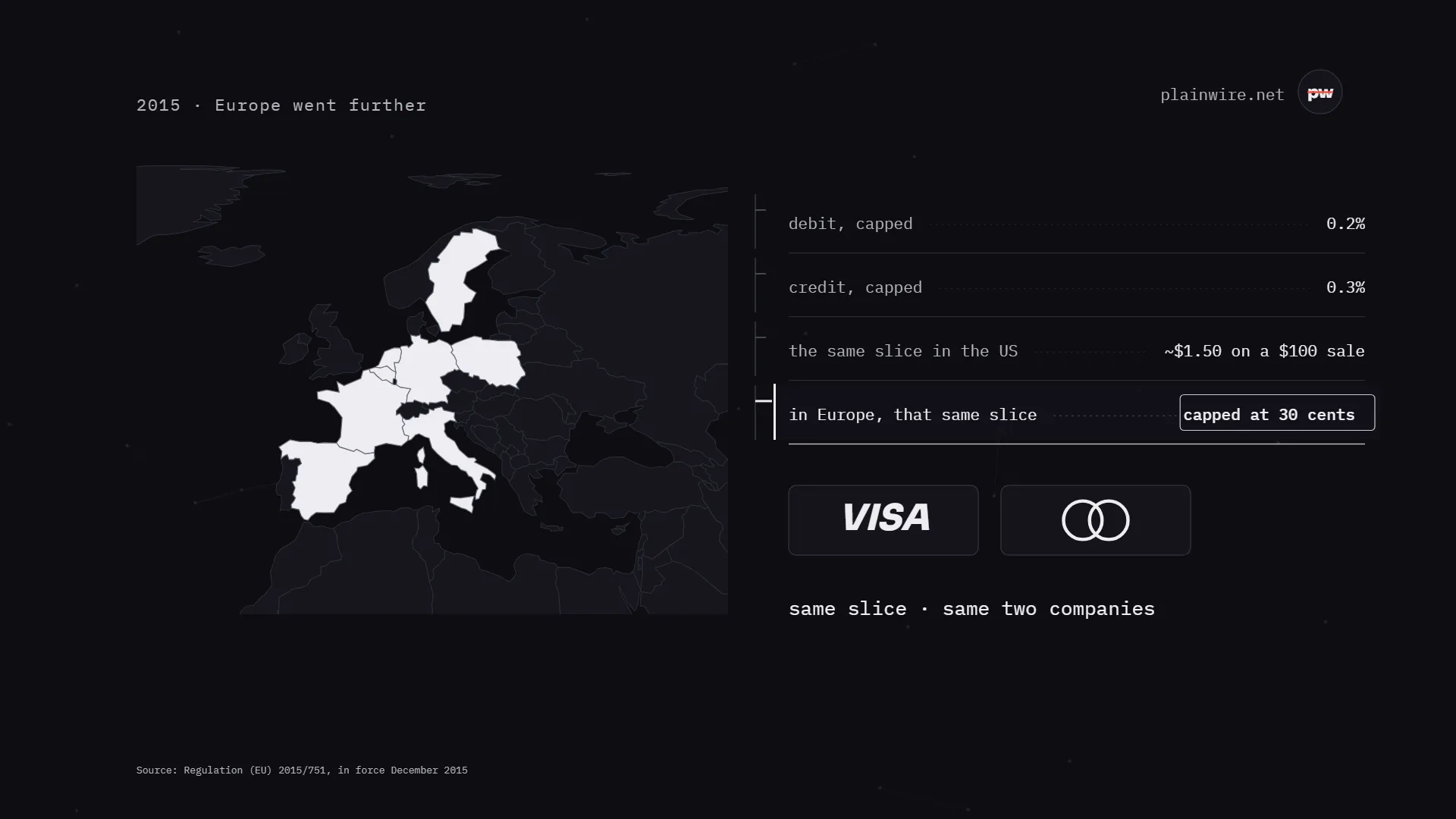
Europe’s 2015 caps on the banks’ slice. Source: Regulation (EU) 2015/751S1.
After Europe capped the interchange fee, shops were supposed to end up paying less. Britain, which was part of the EU at the time, went lookingS1 for whether they did, and found that shops with card turnover between £15,000 and £50 million got little or none of the discount. The cap more or less worked, but the saving stopped one layer above the shop, at the payment companies in between, the ones that plug a shop into the network. The very biggest shops, those above £50 million, did get the full saving passed on. It just didn’t amount to much, because Visa raised its interchange on high-value transactions once the caps took effect. So at one end the middlemen kept it, and at the other end Visa took it back. The payment companies in the middle are also consolidating. In 2025, one of them, Global Payments, bought another, WorldpayS3, for $22.7 billion, and the combined company now handles about $3.7 trillion a year.
Back in the United States, there’s a caseS2 that has been running since 2005. A $30 billion settlement from Visa and Mastercard to merchants was rejected in 2024S2 as too small. A second one, worth about $38 billion in savings to merchants over five years, got preliminary approvalS2 in June 2026, covering 12 million businesses. It still isn’t final. A final approval hearing is expected late in 2026 or early 2027, and the merchants who object have already said they will appeal. It’s a private settlement between companies, not a new law, and it could run for years. Here is what 21 years of litigation in the United States has produced so far: the swipe fee comes down by only 0.1%, for five years. Per $100, that’s 10 cents off the swipe fee. Twenty-one years of fighting, for 10 cents.
What the US merchant case has produced so far. Sources: Payments DiveS2, American Bar AssociationS2.
The merchants who objected to that settlement all made the same point: Walmart, the convenience stores, the restaurants and the retail federation. Their argument is simple. The settlement caps interchange, the slice Visa and Mastercard collect and hand straight to the banks. It does nothing to the scheme fee, the slice Visa and Mastercard keep. So the networks could give up a little interchange and take it back through the fee nobody caps. In the American Bar Association’s summaryS2, the objection is that the agreement “fails to cap network assessment fees, paid by retailers to Visa and Mastercard for access to their payment networks, meaning they could offset any interchange concessions through uncapped increases elsewhere.” After 21 years, the invisible scheme fee still isn’t in the case.
Canada tried a different approach, negotiating rather than legislating, and brought small-business credit interchange down to about 0.95%S1, or 95 cents on your $100, while leaving out medium and larger merchants. Australia is going furthest. From the 1st of October 2026, Australia ends surchargingS1 and caps the interchange feeS1: 8 cents on a $100 for domestic debit cards, and 0.3% for credit cards, or 30 cents on a $100, the same as the EU. From April 2027, the cap on foreign-issued cards is 1%, a dollar on your $100. So there are different places and different methods, and the same shape every time. The published fee, interchange, comes down. The savings mostly stop with the payment companies in the middle before they reach the shops. And the fee nobody publishes, the scheme fee, never enters the main conversation.
the loan inside the card
The banks and the card networks have an answer to all of this, and it deserves a hearing. Their position is that the fee pays for things: fraud systems, the risk that you don’t pay your bill, the people who sort it out when a payment goes wrong, a network that works in 200 countriesS1 and essentially never goes down, and your card rewards. Cut the fee, the argument goes, and the banks and networks that provide all that come under real strain. The first part of that, the claim that all of it costs real money, is true. Card fraud worldwideS1 came to $33 billion in 2024, against global card volume of $51.92 trillion, so fraud is about 0.06% of all card volume. Somebody carries that, and mostly it’s the banks that issued the cards. The second part, the claim that a cut would leave the banks struggling, is debatable. The Federal Reserve Bank of New YorkS1 looked at it using the banks’ own regulatory filings, covering about 90% of the United States credit card market.
Card fraud worldwide in 2024, against global card volume. Source: The Nilson ReportS1.
To follow what it found, you need one basic idea. When you carry a balance on a credit card, you’ve taken out a loan: an actual loan, unsecured, at whatever rate is printed on your statement. To the bank, that loan is an asset, because it’s money owed to them. So you can ask about credit cards the same question you’d ask about any other lending: how much does the bank earn, per dollar it has out on loan? That number is called return on assets. Across banking as a whole, it runs at roughly 1.5%S1.
For credit cards, the Federal Reserve Bank of New York foundS1 that the return on assets is 6.8%, more than four times the rest of banking. That’s on the riskiest lending banks do, where there’s no house and no car behind the debt, so if a borrower defaults there’s nothing for the bank to take back directly. It still makes four times the return, and the reason is printed on the monthly credit card statement: the average United States credit card interest rate is about 23%. If you’re wondering how 23% comes out as 6.8%, the gap is the difference between what a bank charges and what it keeps. Out of the 23% come the bank’s own cost of borrowing, the losses from people who never pay it back, and the cost of running the whole operation. What survives all of that is the 6.8% return on lending.
From the 23% a card charges to the 6.8% a bank keeps. Source: Federal Reserve Bank of New YorkS1.
Here’s an illustration with two consumers. Both spend $1,000 a month on their credit cards, $12,000 a year each, with identical shopping. On the first consumer’s $12,000 of spending, at about 2%, the shops she buys from pay roughly $240 in swipe fees over the year. Most of that, around $180, goes to her bank as the interchange fee. The shop’s payment company takes the bigger portion of what’s left, and Visa or Mastercard get the rest. She’s on a rewards card paying 1% back, so about $120 comes back to her as points, and her bank is left with around $60. She pays her balance in full every month, so she never pays interest.
Now the second consumer. It’s the same $12,000 of spending, so the shops pay the same $240 in swipe fees and his bank collects the same $180. But he doesn’t clear his balance. He pays some of it each month and rolls the rest over, and it settles at around $3,000. That $3,000 is the loan, and at 23% it costs him about $690 a year in interest. The shopping and the swipe fees are the same, but the interest alone is almost four times what the swipe fees paid his bank.
That reorders the whole fight. Every lawsuit, every bill, 21 years of litigation and, by one advocacy group’s countS2, roughly $200 million of lobbying since 2023: all of it over the swipe fee. For the banks collecting it, the swipe fee is the smaller line, and the return on lending is much bigger. That isn’t a defense of the swipe fee. It makes the case for capping it stronger, because the thing the banks say a swipe fee cap puts at risk, the whole banking system, turns out not to be at risk: the banks keep earning bigger profits elsewhere. It also means that if the concern is people being overcharged without noticing, the swipe fee isn’t the largest number on the page. The 23% interest on credit cards is. There’s a newer version of the same thing, too: buy now, pay later, sold as interest free. Fall behind on a $100 grocery loan, and by one borrower-advocacy group’s modelingS3, the late fees work out like borrowing at somewhere between 139% and 208%.
There’s also a clear incentive on the banks’ side to keep the system as it is, and it shows in lobbying money. In Brussels, Visa and Mastercard each declareS2 slightly under €1 million a year on payments lobbying. The main merchant bodies, EuroCommerce and Independent Retail Europe, declare about the same. But the European banking industry’s own federation declares €4 million to €4.5 million a year. So the banks, who keep the interchange fee, outspend each of the networks that set it by roughly four to one. These are self-declared figures, and the European Court of AuditorsS1 has found that the register’s enforcement falls short.
the second network
A lot of money is spent defending the card system as it stands. In the United States, on paper, there’s plenty of competition: Visa, Mastercard, American Express and Discover. But you choose between them once, when you get a credit card. After that, every payment on the card goes down its one network, and the shop pays that network’s price. And because Visa and Mastercard control so much of the marketS1, there is no real competition to challenge them. In other countries, like Britain, there are no local alternatives at all, just Visa and Mastercard, which handle 99% of all card payments in BritainS1. Here’s why that matters. The network on your card is the only road the payment can travel: one network, one road. And a road only works if both ends are on it. Your bank puts the network on your card, and the shop’s payment company has to be connected to it as well, or the shop can’t take that card at all. Some other wealthy countries did build second networks. France has Cartes BancairesS1. Germany has Girocard, Canada has Interac and Australia has eftpos. Italy, Portugal, Norway and Denmark all built their own. In those countries, the card in your wallet usually carries two networks at once, the domestic one on one side and Visa or Mastercard on the other, and whichever network the payment is sent down is the one that gets paid. Send it down the domestic one, and Visa and Mastercard aren’t in the transaction at all.
The countries that do have their own networks are now starting to wire them together. In February 2026, five European payment providers signed a memorandum of understandingS3 to link their systems into one network that works across borders. It’s designed to cover 130 million people across 13 European countries by 2027. The alliance of national systems is called EuroPA, and the other half of it, run by the European Payments Initiative, goes by the consumer brand WeroS3. The joint network doesn’t have a public name yet, but the pitch is clear: a way to pay across Europe without routing the money through an American company.
If a card carries two networks, who decides which one the payment goes through? In Australia, since 2017, the shop decides. It’s called least-cost routing, and it cuts what a shop pays on debit by nearly 20%S1, for changing nothing except which network the payment takes. That’s roughly what a United States bill that keeps failing to pass would do. America already does this on debit cards, through the Durbin Amendment, and the bill would do it on credit cards too. It’s called the Credit Card Competition Act. It was put before Congress againS3 in January 2026, and it would put a second network on every credit cardS3, with at least one of the two not being Visa or Mastercard. So it’s worth knowing what happened when Australia tried it.
In 2022, Australia’s competition regulator sued MastercardS1 over exactly this, and the network at the center of it is eftpos, Australia’s domestic debit network. The allegationS1 is that once shops could route away from Mastercard, Mastercard went to more than 20 major retailers and offered cheaper Mastercard credit rates, on condition that they sent most of their debit through Mastercard rather than through eftpos, the cheaper option. The detail that makes it work matters well beyond Australia: eftpos doesn’t offer credit cards at all, so it had no way to match a discountS2 on a product it doesn’t sell. Mastercard denies the allegation and says the conduct was legitimate and pro-competitive. The trial ran through 2026, and judgment hasn’t landed yet. Whichever way it goes, the mechanism is the main takeaway: a network that only handles debit cannot compete with an offer that bundles debit with credit.
In scale and volume, Visa and Mastercard handle roughly 90% of card payments outside ChinaS3. Inside China, they barely operate at all. China has its own card network, UnionPay, and in 2025 its interbank system carried 380 billion transactionsS1, which is enormous. But even that isn’t the Chinese payments story, because in the same year Alipay, WeChat Pay and the other payment apps handled over 1.3 trillion transactions, three and a half times as many, going straight from bank account to bank account and bypassing the card systems entirely.
South Korea is another example, and it runs the whole thing in reverse. South Korea’s card marketS2 is built so there’s no interchange fee and no payment company in the middle taking a cut. The shop signs up with each card issuer directly, and the government sets what it pays by law rather than leaving it to a network. For small shops, that band runs from 0.4% to 1.45%S1, and it covers about 96% of Korean card merchantsS2. Call it an average of 93 cents on your $100 credit card payment, against $2.30 in the United States. That flips the usual order: in South Korea, large merchants pay more than small onesS1. Everywhere else, usually, a corner shop pays several timesS1 what a supermarket chain pays for exactly the same service. So put those countries together: France, Germany, Canada, Australia, China and South Korea. Every one of them either built an alternative or wrote the price into law. That tells you the average 2% swipe fee isn’t what moving money costs. It’s a working, profitable model for the payment infrastructure providers.
the road with no toll
A country that wants to challenge the existing swipe fee has to build its own infrastructure, and some countries not only did that but went a step further and did away with the card swipe fee altogether. In November 2020, Brazil’s central bank launchedS1 a payment system called PixS1. There’s no card. You pay from your own banking app, by scanning a QR code or entering a phone number, and the money moves straight from your bank account to the shop’s, at any hour. For consumers it’s free. Merchants still pay something, just far less: 0.33%S1. In the second half of 2025, Pix carried 54.7% of every retail payment made in BrazilS2, counted by number: not just of card payments, but of all payments. On a $100 grocery bill in Brazil, that’s about 33 cents to the shop, against $1.13 on a debit card and $2.34 on a credit card.
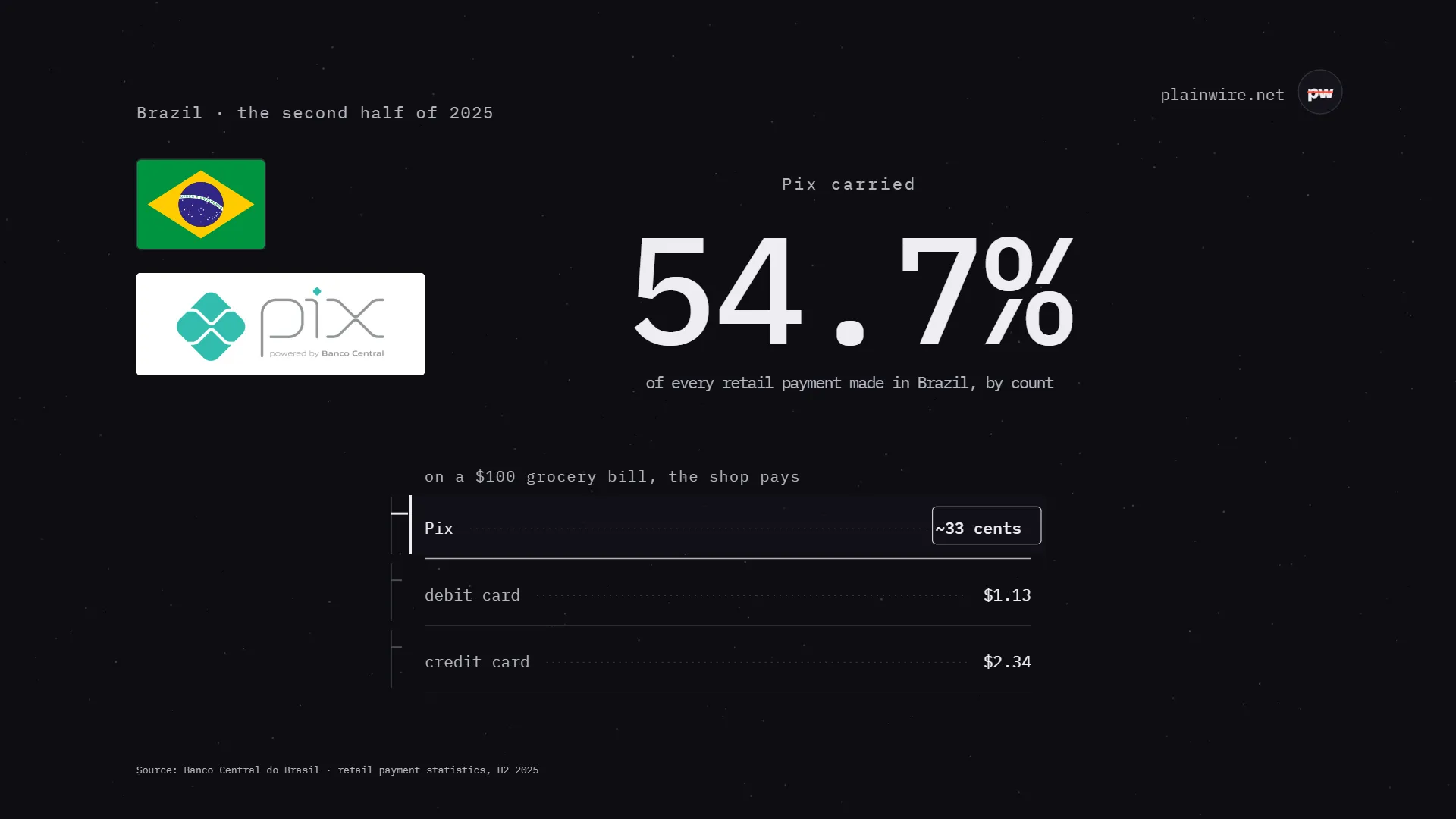
Brazil’s Pix against cards. Sources: ClearingPostS2, Araujo and othersS1.
India is another case. Its instant payment system, UPIS1, processed 228 billion transactions in 2025, handling over 84% of the country’s digital payment volume and outpacing the traditional card networks. From January 2020, federal law banned merchant swipe feesS1 on it across all shops, making payments completely free for both consumers and merchants, while government subsidies compensated the banksS1. The subsidies are focused on small-business purchases of up to ₹2,000, about $21, and those purchases make up about 86% of all merchant transactions in India.
How come the United States, the wealthiest country on earth, doesn’t have a system like Brazil’s Pix or India’s UPI? It does, but most people have never heard of it. It’s called FedNow, it launched in 2023, and it’s growing fast. In its first year, FedNow handled about 47,000 paymentsS1. In 2025, 8.4 million. Over 1,700 banks and credit unionsS1 have joined, which the Federal Reserve says puts FedNow within reach of about half of American checking and savings accounts. The Federal Reserve charges a bank 4.5 centsS1 to send one payment: not a percentage of the payment, but a flat 4.5 cents, whether it’s a $10 or a $10,000 transaction. By the middle of 2026 it was running about 55,000 payments a dayS1. Brazil’s Pix handles about 218 millionS2. But the two systems aren’t doing the same job. The average FedNow payment is about $99,000, and the average Pix payment is about $92. FedNow is moving payroll and property settlements; it isn’t at the grocery till yet. So FedNow’s growth is real, but the gap is huge. The difference is that Brazil’s central bank built Pix and required the banks to join, India made its system free by statute, and in the United States joining FedNow is entirely voluntary.
This is where the story of toll-free roads has to slow down, because a free payment system isn’t free of consequences. Pix is irreversible: money sent is gone, with no chargeback. Brazil has seen a wave of scamsS2 built on that, and street robberies where victims are forced to transfer money on their phones, which is why Brazil’s central bank has added night-time limits and a refund mechanismS3.
In 2025, a single credential theftS2 moved well over $100 million in Brazil. India’s zero-fee rule costs something different. Setting the merchant fee to nothing removed the business model, so India’s government has been funding the system with incentive payments instead. And in August 2026, a legal amendmentS2 opened the door to merchant fees in the future, though payments remain completely freeS2 for consumers and small businesses. So the 2% swipe fee does buy something. It buys chargebacks, disputes and somebody on the phone. What it doesn’t explain is why the price of that is a percentage of everything you buy, acting like an invisible tax. That’s what makes the alternative systems worth building, even though they currently lack some standards.
These new systems need regulation, or they don’t stay free or cheap on their own. Japan’s largest QR payment app charged shops nothing for roughly its first three yearsS3. That app now has about two thirds of Japanese QR code paymentsS3, and it charges 1.98%S3, or 1.6% for shops that pay a monthly fee on top. So the free system found a price. Notice where it landed: near the card fee, not near the cost of moving the money. That’s the pattern worth noting. The systems that have stayed cheap or free so far, Pix and UPI for example, stayed that way because central banks built the infrastructure and governments wrote the law.
the fee changes shape
The swipe fee is under pressure everywhere. Australia is cutting it. Europe and South Korea capped it. China, Brazil and India built around it. Visa, Mastercard and the banks and financial companies with a stake in them can read the trend line, so it’s worth asking what they’re planning next.
This is where stablecoins come in. A stablecoin is a digital token meant to be worth exactly one dollar, or one euro, or one peso, depending on which currency backs it, because somebody holds real money and assets in reserve behind it. In April 2026, Visa announcedS3 that its stablecoin settlement business had reached $7 billion a year, up 50% in a single quarter. Then, in August 2026, Mastercard completedS3 a $1.8 billion purchaseS2 of a company called BVNK, which moves about $30 billion a year in stablecoin payments around the world.
For scale, $7 billion sounds huge, but Visa moves about $17 trillion a yearS1. So Visa’s stablecoin business is roughly 0.04% of what Visa does. It isn’t replacing your card swipe at the supermarket, at least not for now.
Visa’s stablecoin business against everything Visa moves. Sources: VisaS3, Visa’s annual reportS1.
What stablecoins are replacing is something else. Across 2025, stablecoins moved about $400 billion in real paymentsS3. Roughly 60% of that was businesses paying other businesses across borders, and the rest is largely people sending money home: remittances. That’s the corner of payments where the fees are the worst in the world. The World Bank’s figureS1 for the global average cost of sending a remittance is about 6.5%, nearly three times what a shop pays on a card. On the stablecoin corridors, providers say the same transfer can run under 2%, or even 1%.
So the first real use of stablecoins is against the one fee that’s much higher than the card fee. But something bigger is happening underneath. More than 140 countries and currency unions, representing about 98% of world GDP, are working on a digital version of their own currencyS2, or approving one, and tens of countries are already running live pilots. In some countries, the UAE for example, the central bank has already approved several dirham-backed stablecoinsS2 that can be used in shopsS2, and some are already live. On 21 September 2026, the European Central Bank launched PontesS1, which lets banks settle tokenized transactions with each other in central bank money. The digital euro for everyday payments is a separate project, with a pilot planned for 2027S2. And it isn’t only central banks that are interested in stablecoins; commercial banks are too. In late August 2026, Bank of America, Wells Fargo and more than a dozen other banks were reported to be buildingS2 a joint dollar stablecoin of their ownS2.
The shape of money is being rebuilt, in public, under central banks’ watch. In late June 2026, Visa and Mastercard made another move in this direction, when more than 140 companies announced a shared dollar stablecoin called Open USDS2: Stripe, BlackRock, Coinbase, Google, Shopify, American Express and more, and both Visa and Mastercard. Two companies that compete with each other in almost every market on earth are now sitting in the same consortiumS3, building the same product.
Look at how Open USD is designed to make money, because this part matters. When it launches, expected in late 2026, businesses will be able to create and redeem Open USD for free, with no fees. Instead, every dollar of Open USD in circulation is backed by a real dollar sitting in reserve, earning interest, and nearly all of that interest, minus a management fee, goes back to the companies that distribute it.
Read that against everything so far. The old model is a fee, charged on your purchase and shared among the companies in the network. The new model is interest, earned on money sitting still and shared among the companies in the network.
And that shape should look familiar, because it’s the shape from 1966: a group of companies that compete with each other, jointly building a payment network, jointly owning it and jointly taking the profits from it. That arrangement produced Visa and Mastercard.
There’s a wider version of this. VisaS1 and Mastercard have spent the last decade turning themselves into something other than card networks: fraud screening, tokenization, identity, consulting, foreign exchange and more. For MastercardS1, those services now bring in over $13 billion a year and are growing at more than twice the rate of the card business. So the question of whether Visa and Mastercard get killed by a world of instant bank transfers may already be out of date. The card fee is the thing under pressure, but these companies are busy becoming something the card fee no longer defines.
so, to conclude
So where did the $2 from your $100 grocery bill go? Most of it went to your bank and the shop’s payment company. A smaller piece went to a company whose fee nobody caps. And the shop has likely put all of it into the shelf price, which means you paid it whether you used a card or cash.
What does that cost a household? In the United States, shops paid $198 billionS1 in card fees in 2025. Spread across about 134 million American householdsS1, that’s about $1,500 a household a year. It’s an estimate, and there are plenty of nuances, but the picture is clear. Nobody voted on it. It doesn’t appear on receipts. And most of the people paying it have never heard the words interchange or scheme fee.
An estimate: total merchant card fees, business spending included, divided across households. Sources: The Nilson ReportS1, Merchants Payments CoalitionS3, FREDS1.
The global financial infrastructure is changing, and where it goes next is still an open question, but the signs are already there. Countries are building payment systems with zero fees, and in China, Brazil and India those systems already carry more payments than the card networks do. The United States’ FedNow is growing fast too, while more than 140 countries are working on digital versions of their own money. And Visa and Mastercard are rebuilding underneath all of it, on systems with potentially no fee or a fraction of one, while turning themselves into companies that sell far more than card payments.
There are two dates worth following. On the 30th of October 2026, Australia makes Visa and Mastercard publish what they chargeS1, for the first time anywhere in the world. On the 30th of January 2027, Australia makes the payment companies publish how much of the savings reached the shops. Sixty-eight years after Bank of America sent 60,000 credit cards to one town in California, Australia will finally get the first honest look inside the card fee.
Two dates worth following. Source: Reserve Bank of AustraliaS1.
questions this episode answers
Who keeps the fee on a card payment?
Most of it goes to the bank that issued the card, as interchange. The shop's own payment company takes a cut. The smallest piece usually goes to Visa or Mastercard, for running the network the payment traveled over.
Which part of the fee is regulated?
The bank's slice. Interchange is capped in places like the EU, Britain, Australia, Brazil and Canada, and Visa and Mastercard publish every rate. The networks' scheme fee is capped nowhere and is not published.
Do you pay it if you use cash?
Most likely, although no receipt shows it. Shops price their costs into what they charge, so the fee probably reaches you whether you pay by card or in cash.
How much does it add up to?
Shops in the United States paid $198 billion in card fees in 2025. Spread across about 134 million households that is roughly $1,500 a household a year, which is an estimate rather than a bill anyone receives.
Has any country built a way around the swipe fee?
Brazil. Its central bank launched Pix in 2020, a payment system with no card and no swipe fee, and by the second half of 2025 it carried 54.7% of the country's retail payments.
What are the card networks building next?
One answer is stablecoin settlement. Visa said in April 2026 that its stablecoin settlement business had reached $7 billion a year, which is about 0.04% of the $17 trillion Visa moves, so it is early.
sources
Every source in this article, grouped by the kind of document it is. The small tag after a link in the text says which group it belongs to.
S1 · the record
Regulators, central banks, governments and courts; companies' annual reports and official filings; specialist data providers and peer-reviewed research.
- The Nilson Report, Merchant Processing Fees in the United States Exceeded $187 Billion in 2024, 19 March 2025
- European Parliament and Council of the EU, Regulation (EU) 2015/751 on interchange fees for card-based payment transactions, 29 April 2015
- The Nilson Report, Amex, Discover, Mastercard and Visa Card Spending Exceeded $10 Trillion in 2024, 25 February 2025
- Visa, Fees and interchange (Visa in Europe)
- Mastercard, Interchange Fees and Rates Explained
- Reserve Bank of Australia, Backgrounder on Interchange and Scheme Fees
- Reserve Bank of Australia, Payments System Board announces reforms to merchant card payment costs and surcharging, 2026
- Banco Central do Brasil, Estudo Especial nº 106/2021: Avaliação do resultado regulatório da introdução de limites para a tarifa de intercâmbio de cartão de débito, 2021
- Government of Canada, Government of Canada announces finalized agreements with Visa and Mastercard to lower credit card transaction fees for small businesses, 5 December 2023
- Reserve Bank of Australia, Review of Merchant Card Payment Costs and Surcharging: Conclusions Paper, Chapter 4, Scheme Fees, 31 March 2026
- Reserve Bank of Australia, Review of Merchant Card Payment Costs and Surcharging: Conclusions Paper (full report), 31 March 2026
- Visa Inc., Annual Report on Form 10-K for the fiscal year ended 30 September 2025
- The Nilson Report, Merchant Processing Fees in the United States: 2025
- Federal Reserve Bank of Boston, Who Gains and Who Loses from Credit Card Payments? Theory and Calibrations (Schuh, Shy and Stavins), August 2010
- Federal Reserve Board and International Monetary Fund, Who Pays For Your Rewards? Redistribution in the Credit Card Market (Agarwal, Presbitero, Silva and Wix), 2023
- UK Payment Systems Regulator, Market review of card scheme and processing fees: final report
- Federal Reserve History, Electronic Point-of-Sale Payments
- US Bureau of Labor Statistics, CPI Inflation Calculator
- Visa Inc., Quarterly Report on Form 10-Q after the March 2008 initial public offering, 2008
- Visa Inc., Current Report on Form 8-K, 23 December 2025
- Supreme Court of the United States, Corner Post, Inc. v. Board of Governors of the Federal Reserve System, 603 U.S. 799, 1 July 2024
- Board of Governors of the Federal Reserve System, Regulation II (Debit Card Interchange Fees and Routing)
- Federal Reserve Board, Bank Profitability and Debit Card Interchange Regulation: Bank Responses to the Durbin Amendment
- Journal of Financial Economics, Price regulation in two-sided markets: Empirical evidence from debit cards, 2025
- Federal Reserve Bank of Richmond, The Impact of the Durbin Amendment on Merchants: A Survey Study (Wang, Schwartz and Mitchell), 2014
- European Commission (study by EY and Copenhagen Economics), Study on the application of the Interchange Fee Regulation, March 2020
- UK Payment Systems Regulator, Card-acquiring market review: final report, 3 November 2021
- Reserve Bank of Australia, Review of Merchant Card Payment Costs and Surcharging: Conclusions Paper, Interchange Fees, 31 March 2026
- The Nilson Report, Global Card Fraud Losses at $33 Billion, 7 January 2026
- Federal Reserve Bank of New York, Credit Card Banking (Staff Report No. 1143)
- European Court of Auditors, Special Report 05/2024: The EU Transparency Register, 2024
- European Commission, Decision 92/212/EEC (Groupement des Cartes Bancaires CB), 1992
- Reserve Bank of Australia, The Effect of Least-cost Routing on Merchant Payment Costs (Bulletin), April 2024
- Australian Competition and Consumer Commission, Mastercard in court for alleged misuse of market power over card payments, 30 May 2022
- Australian Competition and Consumer Commission, ACCC v Mastercard Asia/Pacific: Concise Statement, May 2022
- People's Bank of China, via China National Clearing Center, Payment system operation in 2025, March 2026
- Financial Services Commission, Korea, Press release on preferential card fee rates
- UK Payment Systems Regulator, Choosing how to pay: how it works in South Korea
- Bank for International Settlements, Central banks, the monetary system and public payment infrastructures: lessons from Brazil's Pix (Bulletin No 52), 23 March 2022
- Banco Central do Brasil, Pix
- Araujo and others (peer-reviewed), Fast payment systems and central bank digital currencies: Evidence from Pix and the Drex in Brazil, 2026
- National Payments Corporation of India, UPI product statistics
- Press Information Bureau, Government of India, Zero merchant discount rate on RuPay debit cards and BHIM-UPI
- Press Information Bureau, Government of India, Cabinet approves Incentive scheme for promotion of low-value BHIM-UPI transactions (P2M), March 2025
- Federal Reserve Bank of Kansas City, Leveraging modern payments infrastructure in community banking (speech), May 2026
- Federal Reserve Financial Services, FedNow Service volume and value statistics
- Federal Reserve Financial Services, FedNow Service 2026 fee schedule
- Federal Reserve Bank of Richmond, FedNow and the Development of U.S. Fast Payments (Economic Brief 26-28, Wang and Phan), August 2026
- World Bank, Remittance Prices Worldwide
- Mastercard Incorporated, Annual Report on Form 10-K for the fiscal year ended 31 December 2025
- US Census Bureau, via FRED (Federal Reserve Bank of St. Louis), Total Households (TTLHH)
- Mastercard (SEC filing), Form 10-Q, quarter ended 30 June 2006: use of the IPO proceeds, 2006 about $1.8 billion of the net proceeds went to redeeming member banks' Class B shares
- European Central Bank, Pontes, launched 21 September 2026
S2 · reporting and analysis
Established news outlets and analysts describing or interpreting the record.
- American Bar Association, Antitrust Law Section, In re Payment Card Interchange Fee and Merchant Discount Antitrust Litigation (case summary)
- Marketplace, A short history of the debit card, 18 August 2011
- The Motley Fool, If You'd Invested $10,000 in Mastercard's IPO, This Is How Much Money You'd Have Now, 18 February 2020
- CBS News, Visa Raises $17.9B In Largest IPO Ever, March 2008
- Cooley LLP, District Court Vacates Regulation II's Debit Card Interchange Fee Standard, 15 August 2025
- Ballard Spahr, Consumer Finance Monitor, N.D. district court invalidates longstanding debit card interchange rule, 14 August 2025
- CNN Business, Federal judge rejects $30 billion settlement between Visa, Mastercard and retailers, 25 June 2024
- Payments Dive, Court approves Visa-Mastercard settlement, 9 June 2026
- Forbes, Why The Credit Card Industry Is Spending $200 Million To Oppose This Legislation While Big Box Retailers Support It (Alison Durkee), 23 July 2026 the $200 million is a count by Demand Progress, an advocacy group
- LobbyFacts.eu, Visa Europe datacard compiled from the EU Transparency Register; the figures are self-declared
- Lexology, ACCC v Mastercard and the eftpos bundling question
- Glenbrook Partners, The South Korean Card Market's Fascinating Structure
- Korea Bizwire (Yonhap), Credit Card Fee Relief to Reach 95.7% of Korean Merchants This Year, 13 August 2025
- ClearingPost, Pix reaches 54.7% of retail transactions (Banco Central do Brasil, H2 2025)
- ClearingPost, PIX Breaks All Records in 2025: 79.8 Billion Transactions
- Scroll.in (Thomson Reuters Foundation), Scams, blackmail to even kidnapping: gangs thrive as Brazil adopts instant payment app, 28 June 2023
- American Banker, Brazilian heist highlights real-time payment fraud concerns
- Forbes India, What is merchant discount rate on UPI and why does India want to bring it back?
- SCC Online, No Charges on UPI Payments: Government Clarifies What the PSS Act Amendment Really Means, 10 August 2026
- CoinDesk, Inside stablecoin firm BVNK's journey to a $1.8B acquisition by Mastercard, 10 August 2026
- Atlantic Council, Central Bank Digital Currency Tracker
- The National, UAE dirham-backed stablecoin DDSC now more accessible for retail transactions, 5 July 2026
- Digital Watch Observatory, UAE Central Bank approves dirham stablecoin for retail use, July 2026
- Payments Dive, Banks undertake stablecoin effort, September 2026
- The Daily Hodl, Bank of America, Wells Fargo, Citi and Goldman Join 21-Firm Plan to Launch Stablecoin, 1 September 2026
- The Defiant, Open Standard unveils Open USD stablecoin consortium with BlackRock, Visa, Mastercard
- NBC News (Associated Press), MasterCard to pursue initial public offering, 31 August 2005 controlled by 1,400 financial institutions before the listing
- CoinDesk, ECB deploys Pontes platform to settle wholesale tokenized assets in central-bank money, 21 September 2026
S3 · interested or secondary
Press releases, trade groups and campaigners, and explainers and summaries used for background.
- Payments Mastery, Interchange Fees Explained: Complete Payment Fee Breakdown & Money Flow industry explainer
- Finix, Understanding payment processing fees explainer from a payment processing company
- Chargebacks911, Get the Rundown on Mastercard Interchange Rates for 2026 industry explainer
- Office of Sen. Dick Durbin, Durbin, Marshall Reintroduce the Credit Card Competition Act, 13 January 2026 press release from the bill's sponsors
- Checkout.com, What are interchange fees? Pricing and charges explained explainer from a payment company
- Merchants Payments Coalition, Credit and Debit Card ‘Swipe’ Fees Reach Record $198.25 Billion as President and Congress Call for Action, 18 March 2026 merchant coalition that campaigns on swipe fees; the figure is the Nilson Report's
- FMI, The Food Industry Association, Food Industry Facts trade association for food retailers
- PERC, A Re-examination of Who Gains and Who Loses from Credit Card Payments, 2013 industry-aligned; disputes the 2010 Boston Fed paper
- International Center for Law & Economics, The Reverse Robin Hood Fallacy, 2021 industry-aligned; disputes the 2010 Boston Fed paper
- Diners Club International, History and Legacy company history page
- American Express, Inside the heated debate that led to American Express' first credit card in 1958 company newsroom
- Andreessen Horowitz, The Fresno Free-for-All Behind the Original Credit Card venture capital firm's history piece, based on Joseph Nocera's book
- Ecommerce Europe, The Interchange Fee Regulation turns 10 trade association funded by online retailers
- Global Payments Inc., Global Payments Announces Agreements to Acquire Worldpay and Divest Issuer Solutions, 17 April 2025 company announcement
- Protect Borrowers, How Buy Now, Pay Later Lenders are Racing to Put 'A Loan in Every Cart', 13 July 2026 borrower advocacy group
- European Payments Initiative, Bancomat, Bizum, EPI, SIBS and Vipps MobilePay sign MoU to accelerate the rollout of sovereign pan-European payment solutions, 2 February 2026 company announcement
- BNP Paribas, BNP Paribas partners with Wero for e-commerce payment solutions company announcement
- Office of Rep. Zoe Lofgren, Lofgren, Gooden Reintroduce Bipartisan Bill to Lower Americans' Credit Card Swipe Fees, 13 January 2026 press release from the bill's sponsors
- Quartr, Visa and Mastercard: The Global Payment Duopoly secondary source
- The Level One Project, Complaint and Funds Refund Mechanism in Brazil explainer
- PayPay Corporation, Total Number of PayPay Transactions Exceeded 7.46 Billion in 2024, 31 March 2025 company announcement
- PayPay Corporation, Payment System Fee for PayPay Merchants from October 2021, 19 August 2021 company announcement
- Visa Inc., Visa Accelerates Stablecoin Momentum, Adding Five Blockchains for Settlement, 29 April 2026 company announcement
- Mastercard, Mastercard completes acquisition of BVNK to advance global stablecoin capabilities, 3 August 2026 company announcement
- Bessemer Venture Partners, Stablecoins: from DeFi primitive to global financial infrastructure venture investor; the figures are Artemis and Allium data, and estimates vary widely
- Open Standard, Open USD the consortium's own materials
A tag says what kind of document is behind a link. It isn't a verdict on whether the source is right. More in the standards.